


As a supplier of double faced steel pallets, I often encounter technical inquiries from customers. One question that has piqued my interest recently is: What is the Poisson's ratio of double faced steel pallets? In this blog, I'll delve into this topic, explaining what Poisson's ratio is, its significance for double faced steel pallets, and how it relates to the overall performance of these essential industrial tools.
Understanding Poisson's Ratio
Poisson's ratio is a fundamental concept in materials science and engineering. It is named after the French mathematician Siméon Denis Poisson, who first described it in the early 19th century. Poisson's ratio, denoted by the Greek letter ν (nu), is defined as the negative ratio of the transverse strain to the axial strain when a material is subjected to uniaxial stress.
Mathematically, it can be expressed as:
ν = -ε_transverse / ε_axial
Where ε_transverse is the transverse strain (the change in dimension perpendicular to the applied force) and ε_axial is the axial strain (the change in dimension parallel to the applied force).
For most materials, Poisson's ratio ranges between 0 and 0.5. A value of 0 would mean that the material does not deform transversely when subjected to axial stress, while a value of 0.5 indicates that the volume of the material remains constant during deformation.
Poisson's Ratio in Steel
Steel is a widely used material in the manufacturing of double faced steel pallets due to its high strength, durability, and resistance to corrosion. The Poisson's ratio of steel typically falls within the range of 0.25 to 0.33. This value can vary slightly depending on the specific type of steel, its composition, and the manufacturing process.
The relatively low Poisson's ratio of steel means that when a steel pallet is loaded axially (for example, when goods are placed on top of it), it will experience a relatively small amount of transverse deformation. This is beneficial for maintaining the structural integrity of the pallet and ensuring that it can support heavy loads without excessive spreading or distortion.
Significance for Double Faced Steel Pallets
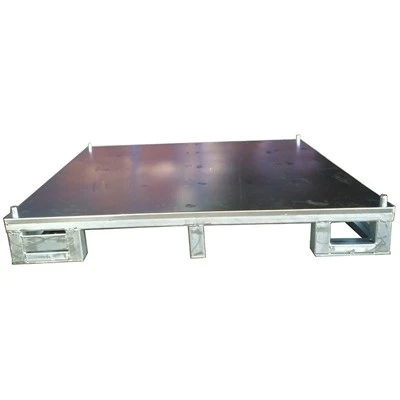
Double faced steel pallets are designed to provide a stable and durable platform for storing and transporting goods. The Poisson's ratio of the steel used in these pallets plays a crucial role in determining their performance under load.
- Load Distribution: A low Poisson's ratio helps to distribute the load evenly across the pallet's surface. When a load is applied axially, the steel's minimal transverse deformation ensures that the weight is transferred efficiently to the pallet's legs or supports, reducing the risk of localized stress concentrations that could lead to failure.
- Stackability: Double faced steel pallets are often stacked on top of each other to maximize storage space. The Poisson's ratio affects how the pallets interact when stacked. A consistent Poisson's ratio ensures that the pallets maintain their shape and stability, preventing them from shifting or collapsing under the weight of the stack.
- Longevity: By minimizing transverse deformation, the low Poisson's ratio of steel helps to extend the lifespan of double faced steel pallets. Reduced deformation means less wear and tear on the pallet's structure, reducing the likelihood of cracks or fractures over time.
Factors Affecting Poisson's Ratio in Double Faced Steel Pallets
While the inherent properties of steel determine its basic Poisson's ratio, several factors can influence the effective Poisson's ratio of double faced steel pallets.

- Manufacturing Process: The way the steel is processed during manufacturing can affect its internal structure and, consequently, its Poisson's ratio. For example, heat treatment processes such as annealing or quenching can alter the grain structure of the steel, potentially changing its mechanical properties.
- Design and Geometry: The design and geometry of the pallet can also impact its Poisson's ratio. Pallets with different shapes, sizes, or thicknesses may exhibit different deformation characteristics under load. For instance, a pallet with a thicker deck may have a slightly different Poisson's ratio compared to a thinner one.
- Surface Treatment: Surface treatments such as Zinc Galvanized Steel Pallet or Powder Coated Steel Pallet can add an additional layer of protection to the steel, but they may also affect its mechanical properties. In some cases, the coating may introduce additional stresses or alter the way the steel responds to deformation.
Measuring Poisson's Ratio in Double Faced Steel Pallets
Measuring the Poisson's ratio of double faced steel pallets requires specialized equipment and techniques. One common method is to use strain gauges, which are devices that can measure the strain (deformation) of a material under load. By applying a known axial load to the pallet and measuring the resulting axial and transverse strains, the Poisson's ratio can be calculated using the formula mentioned earlier.
However, it's important to note that the measured Poisson's ratio may vary depending on the specific testing conditions, such as the location and orientation of the strain gauges, the magnitude and direction of the applied load, and the presence of any external factors that could affect the measurement.
Applications and Considerations
Double faced steel pallets are used in a wide range of industries, including manufacturing, logistics, and warehousing. Understanding the Poisson's ratio of these pallets is essential for ensuring their proper use and performance.
- Heavy Load Applications: In industries where heavy loads are common, such as automotive or construction, pallets with a low Poisson's ratio are preferred. These pallets can better withstand the high axial forces without excessive transverse deformation, ensuring the safe and efficient handling of goods.
- Automated Handling Systems: In automated warehouses and distribution centers, pallets need to be compatible with conveyor systems and other handling equipment. The Poisson's ratio affects the pallet's dimensional stability, which is crucial for smooth operation in these automated environments.
- Custom Design: For specific applications or unique requirements, custom-designed double faced steel pallets may be necessary. In such cases, the Poisson's ratio can be considered during the design process to optimize the pallet's performance and ensure that it meets the desired specifications.
Conclusion
In conclusion, the Poisson's ratio of double faced steel pallets is an important factor that influences their performance, durability, and suitability for various applications. As a supplier of these pallets, I understand the significance of this technical parameter and its impact on the quality of our products.
Whether you're looking for Zinc Galvanized Steel Pallet, Powder Coated Steel Pallet, or Round Corner Steel Pallet, our team of experts can provide you with the information and guidance you need to make an informed decision. We are committed to delivering high-quality double faced steel pallets that meet the highest standards of performance and reliability.
If you have any questions or would like to discuss your specific requirements, please don't hesitate to contact us. We look forward to the opportunity to work with you and provide you with the best solutions for your pallet needs.
References
- Callister, W. D., & Rethwisch, D. G. (2016). Materials Science and Engineering: An Introduction. Wiley.
- Ashby, M. F., & Jones, D. R. H. (2012). Engineering Materials 1: An Introduction to Properties, Applications, and Design. Butterworth-Heinemann.
- Budynas, R. G., & Nisbett, J. K. (2011). Shigley's Mechanical Engineering Design. McGraw-Hill.


